
The conference commemorates 135 years of research into Homo erectus, the 35th anniversary of the discoveries at Dmanisi, and their significance for the study of human evolution
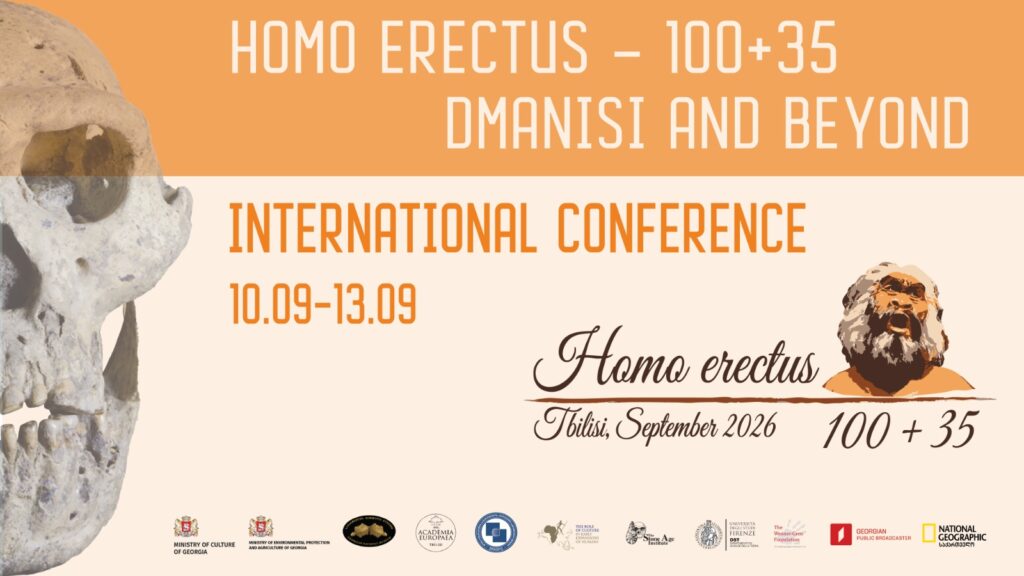
From 9 to 13 September 2026, the Georgian National Museum will host the international scientific conference “100+35 Years of Homo erectus: Dmanisi and Beyond” (dmanisiconference.org).
The conference commemorates 135 years of research into Homo erectus, the 35th anniversary of the discoveries at Dmanisi, and their significance for the study of human evolution.
It is worth noting that in 1991, an international conference in Frankfurt, held at the Senckenberg Research Institute and Natural History Museum, commemorated the 100th anniversary of the discovery of Pithecanthropus erectus. It was at this conference that the first hominin remains discovered in Dmanisi on 24 September of the same year, and dated to 1.8 million years ago, were presented. In 2016, 25 years after this landmark discovery, Georgia hosted the Senckenberg international conference dedicated to the 125th anniversary of Pithecanthropus erectusand the 25th anniversary of the discovery of the Dmanisi hominins.
The conference“100+35 Years of Homo erectus: Dmanisi and Beyond” continues this tradition of scientific conferences and establishes a scientific platform where leading researchers from around the world will deliver lectures on human evolution, paleoanthropology, archaeology, paleontology, early human behavior, and environmental contexts, while sharing the latest results of interdisciplinary research in the field of prehistory.
Scientists from more than 15 countries are participating in the conference. Among them are such legendary figures as Katie Schick and Nicholas Toth, founders of the Stone Age Institute and pioneers of experimental Paleolithic archaeology; Professor Katerina Harvati of the University of Tübingen, one of the world’s leading paleoanthropologists, who in 2026 received the Albert Einstein World Award of Science for her outstanding contribution to the study of human origins and evolution; as well as other internationally renowned researchers.
The conference is also exceptional in bringing together, in a single scientific forum, leading experts from around the world working across different fields of human evolution, alongside scientists at the forefront of contemporary research methodologies.
The conference will open on 9 September at 19:00 at the courtyard of the Georgian National Museum, with public lectures by Professor Michel Brunet (Michel Brunet) and Professor Juan Luis Arsuaga (Juan Luis Arsuaga). The names of these two distinguished paleoanthropologists are associated with some of the most significant discoveries in the study of human evolution.
Professor Michel Brunet (Collège de France) discovered Sahelanthropus tchadensis—Toumaï—in the Republic of Chad, Africa. Dated to approximately 7 million years ago, it is considered one of the earliest known representatives of the human evolutionary lineage.
Professor Juan Luis Arsuaga (Complutense University of Madrid) is one of the leading researchers behind the major discoveries at the Archaeological Site of Atapuerca, Spain. Atapuerca has been inscribed on the UNESCO World Heritage List since 2000, as the fossils discovered there constitute some of the earliest and most significant evidence of human presence in Europe and provide an exceptional source for the study of the physical characteristics and way of life of Europe’s earliest human communities.
The research of Michel Brunet and Juan Luis Arsuaga has fundamentally transformed our understanding of human origins and the evolution of the genus Homo. Bringing these two legendary scientists together in Tbilisi on the same evening is an exceptional event both for Georgia and for the international scientific community.
On 10 September at 10:00, the official opening of the conference sessions will take place in the auditorium of the Georgian National Museum. The scientific sessions will continue through 12 September, while on 13 September, conference participants will visit the Dmanisi and Orozmani archaeological sites.
Over the 135 years of research into Homo erectus, a vast body of new scientific evidence has accumulated. Over the past 35 years alone, at the Archaeological Site of Dmanisi, remains of at least five individuals dating to approximately 1.77 million years ago have been discovered. Today, among hominin remains of this age, the Dmanisi hominins are considered among the best-preserved fossils in the world. Information about the discoveries at Dmanisi has repeatedly been featured in leading scientific and popular publications, including Science, Nature, The Independent, National Geographic, Le Figaro, The New York Times, BBC, CNN, and The Guardian, among others. Notably, in 2000, the paleoanthropological discoveries at Dmanisi ranked third among the world’s ten most important archaeological discoveries.
The concluding session of the conference will examine the role and significance of Georgia, as a country distinguished by its exceptional biodiversity, in ongoing global processes, as well as perspectives for research into biocultural processes and climate change.
The conference is organized through the collaboration of the Georgian National Museum, Shota Rustaveli National Science Foundation of Georgia, Ministry of Culture of Georgia, Ministry of Environmental Protection and Agriculture of Georgia, Academia Europaea Tbilisi Hub, Stone Age Institute, Department of Earth Sciences of the University of Florence, and the Research Center of the Heidelberg Academy of Sciences and Humanities (ROCEEH).
The conference’s media partners are National Geographic Magazine – Georgia and the Georgian Public Broadcaster.